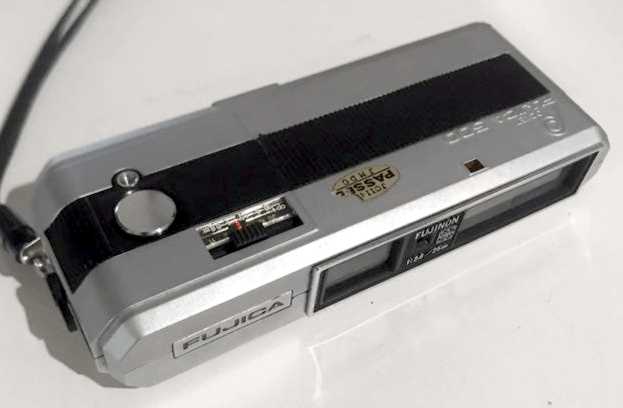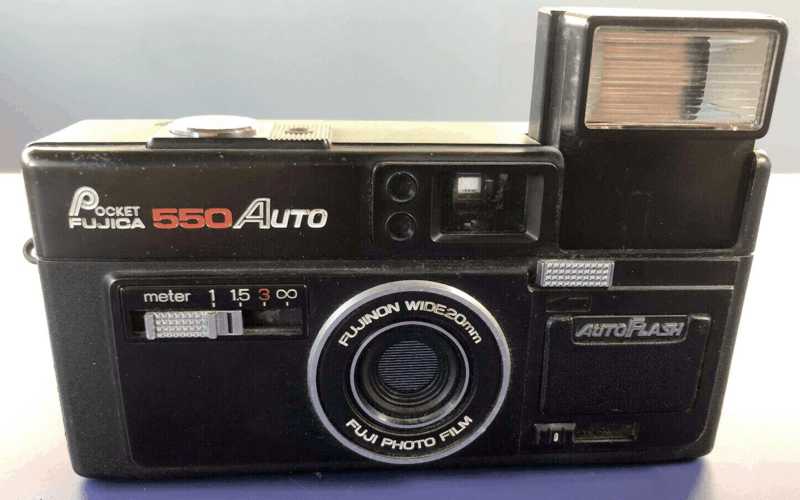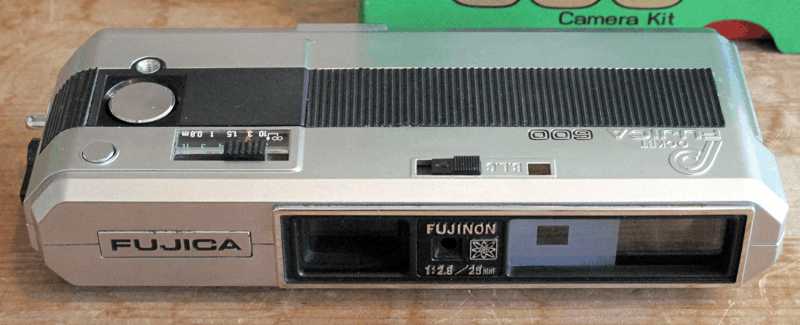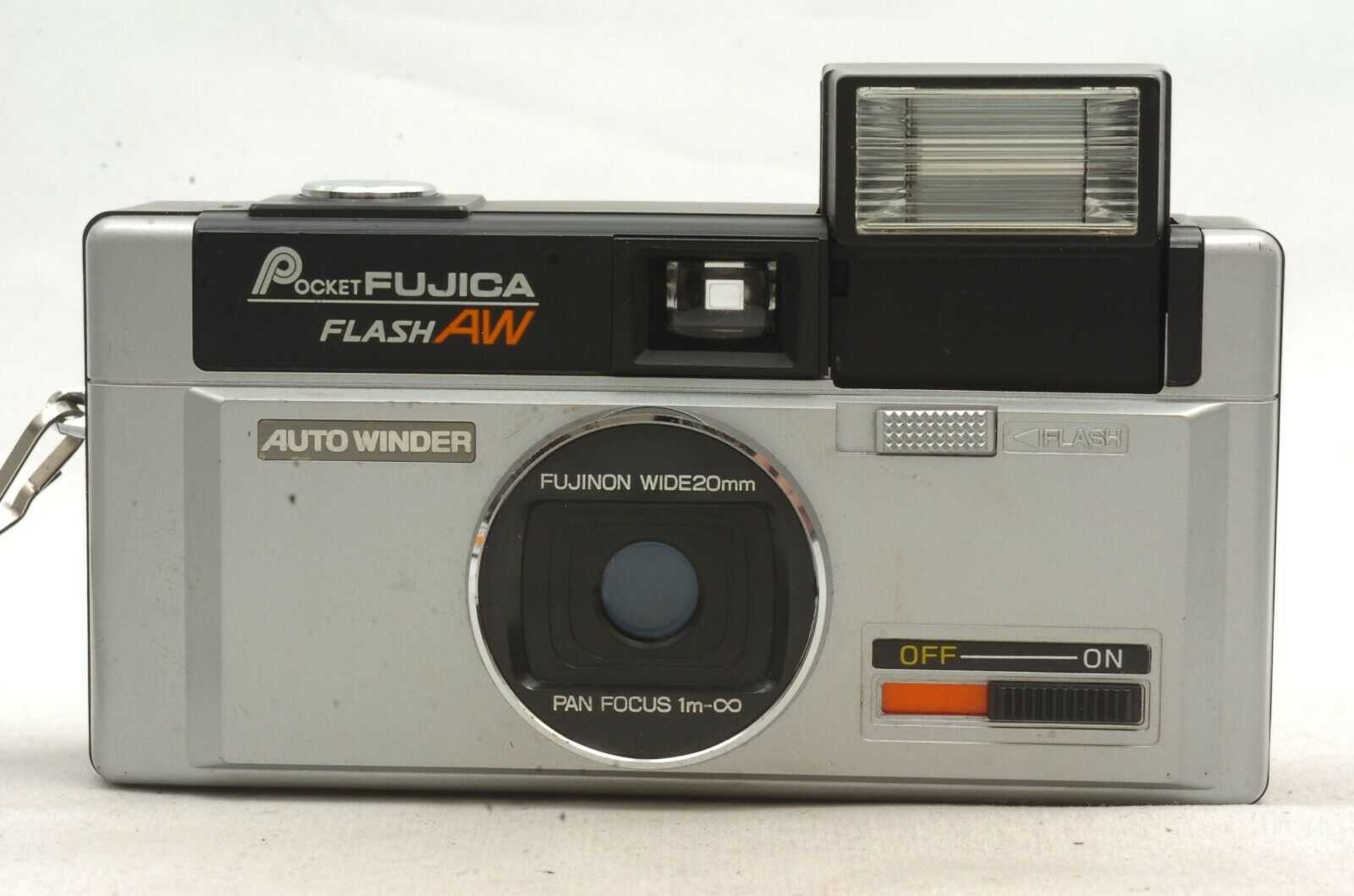
FUJICA 110 CAMERAS
Fuji was quick to jump on the 110 bandwagon. They had never gotten on board the 16mm wagon -- which
was a huge mistake for Fuji, which is a film manufacturer as well as a camera manufacturer. This time Fuji
saw the new 110 camera and film market as a way to rewrite history. And they re-wrote it with a vengeance,
coming out with numerous 110 models, with high quality features, and innovative designs. For example, in
1976, they were the first company to stick a zoom lens on a 110 camera! Some models had unusually fast lenses,
such as f2.8 with a 4/3 Tessar optical design! Many of their 110 cameras used a slightly wider 20mm lens
than is typical on 110 cameras. This allowed for more depth of field (important with fixed-focus lenses),
and was great for groups shots and scenics. Other models had telephoto, in addition to the normal lens, and
many models had built-in hot-shoes -- and Fuji made various, compact, flash units to fit. They even had models
with automatic exposure (controlling the aperture and shutter speed), built-in rangefinder, and automatic film
advance.
Most of Fuji's 110 cameras do not use the 110 film perforations to cock the shutter. This mean that these cameras can be reloaded with 16mm film (in 110 cassettes, of course) -- if a small change is made to the camera or the cassette. The 16mm film can be perforated or unperforated, but if it's perforated the perforation will appear in the mage. Specifically, some of these Fujica cameras have a tiny "cassette sensor" along the edge of the film plane. If a small notch is cut into the edge of the cassette to avoid pushing the sensor in, the camera will operate normally. Other models have a much larger cassette sensor/tab in the bottom of the film take-up chamber. If this sensor is filed or cut off, the camera will work -- or the cassette can be trimmed in the same spot.
If you have additional or corrective information, please contact us.
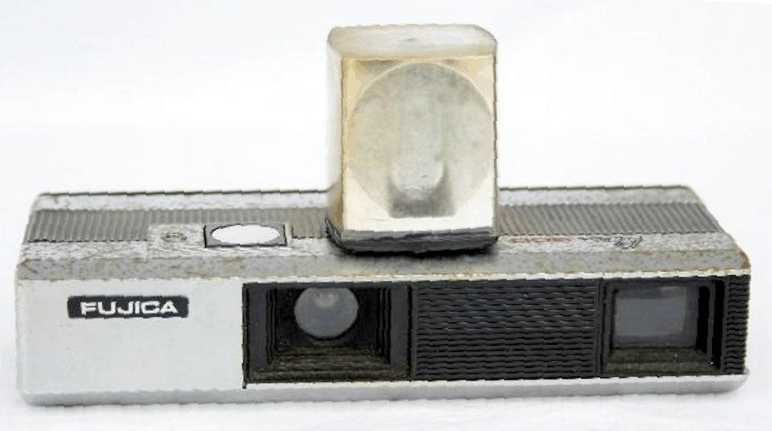
(1977) 29mm (f11.0), (3/3) fixed-focus lens. Mechanical shutter with speed of 1/60. No exposure control -- but it has tripod and cable release sockets. Built-in UV filter. Designed for 100 ASA film. Uses Magicubes.
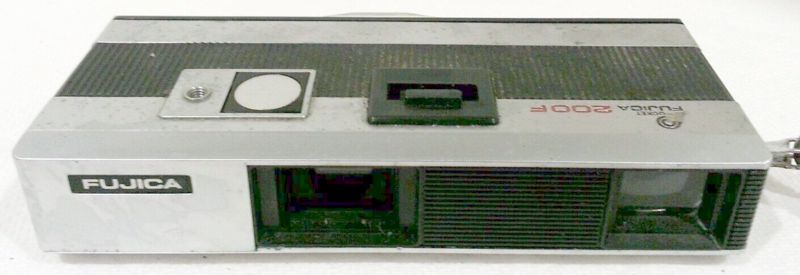
(1977) This was an upgraded version of the Pocket 200. The "F" stands for "FLASH". It has the same 29mm (f11.0), (3/3) fixed-focus lens as the Pocket 200 and the same mechanical shutter with a speed of 1/60. There are no exposure controls, but the camera has a tripod socket, cable release connection, but takes a Flip-Flash instead of the cubes. Built-in UV filter. Designed for 100 ASA film.
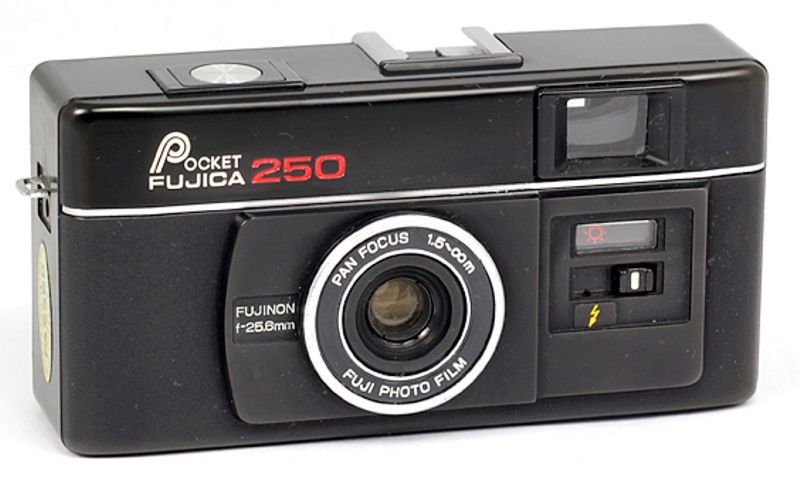
With a completely new, vertical design, it has a faster, wider 25.6mm f9.5, 3-element lens which provides depth-of-field from five feet to infinity. It accepts 100 or 400 speed film. Two weather symbols allow for the selection for SUN or CLOUDY/INDOORS. Also new -- a HOT flash shoe -- which provides a third exposure setting, perfect for use with an auto-flash -- but the flash may only trigger when CLOUDY/INDOORS is selected.
Not to be confused with the Pocket 250, this version used the more traditional horizontal body style, and lacks the extra features of the Pocket 250. The flash is built-in, and has an ON/OFF switch and ready light. Accepts 100 and 400 speed film.
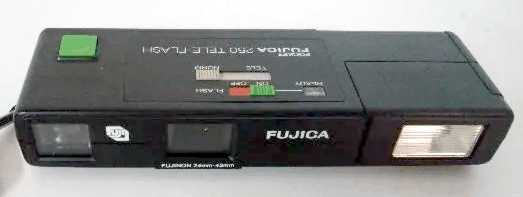
It's the same as the Pocket 250 Flash, but it has an extra switch to select NORMAL or TELE lenses.
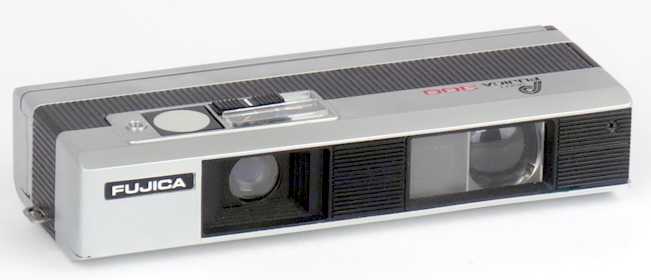
(1975) This was the deluxe version of the Pocket 200 with a much faster 26.5mm f5.6-11 lens. Fixed-focus. Fixed speed of 1/125 of a second. Weather symbols for exposure (aperture) control. Built-in UV filter.
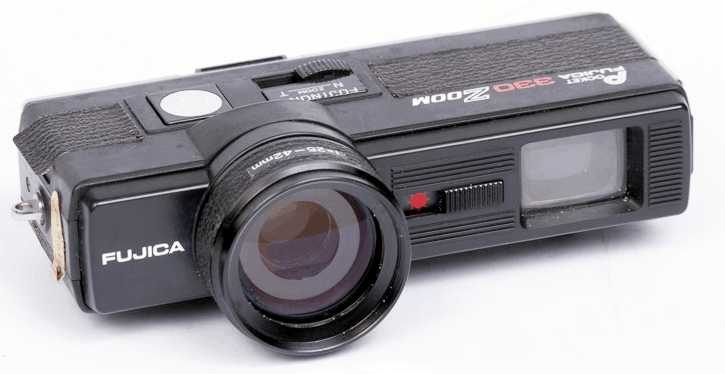
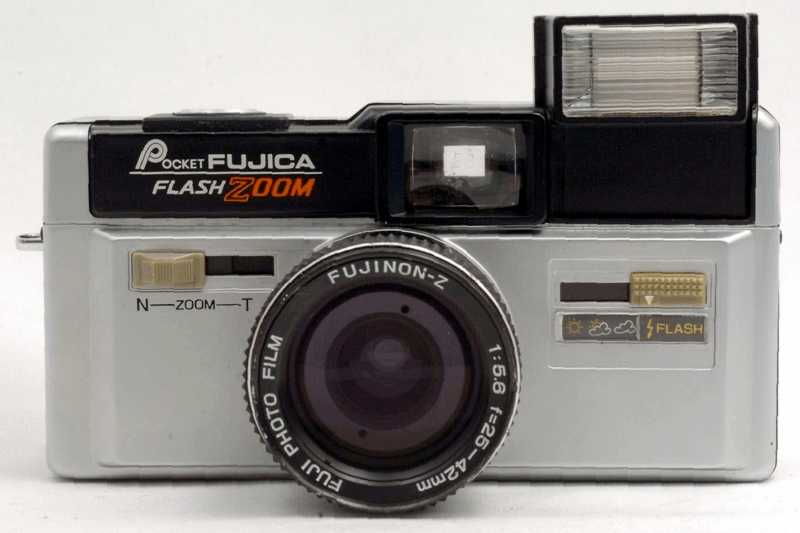
(1977) A scaled-down version of the more expensive Pocket 350 Zoom (see below), but it didn't loose the main feature -- the very nice, normal-to-tele, 25-42mm zoom lens -- controlled by a lever on top of the camera. The other control is a switch on the front of the camera to turn on any hot-shoe-added flash for low-light conditions. Surprisingly, unlike the more expensive Pocket 350 models, the Pocket 330 was only available in all black.
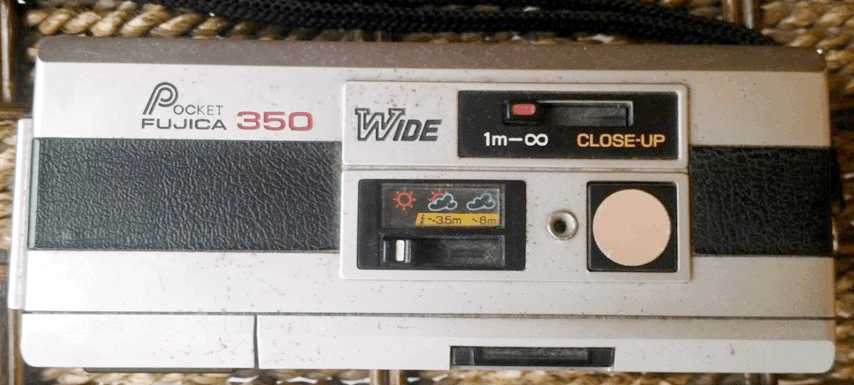
There were four Pocket 350 cameras, but there apparently never was a plain Pocket 350 model (see below).
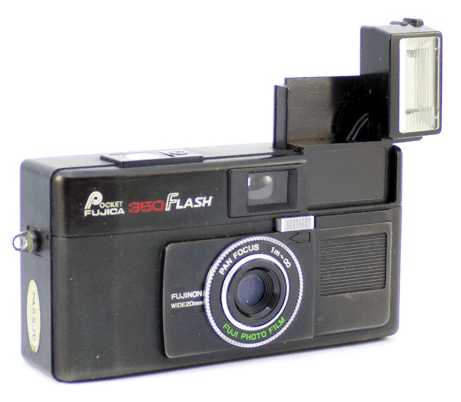
(1978) Unlike the other Pocket 350 models (below), the Pocket 350 Flash was a vertical-styled 110 camera, much like the Pocket 250 -- but NOT like the Pocket 250 Flash, as you might assume. But unlike the Pocket 250, the Pocket 350 Flash had an even wider 20mm f5.6 lens, and not surprisingly, a built-in flash -- that could be used in different positions! It uses two AA batteries.
25mm (f11.0), (3/3) fixed-focus lens -- but although it is a pan-focus lens -- DOF is only from 3.3 feet to infinity -- so they included a slide-in close-up lens. A CDS meter controls the shutter speed with the help of a lever on top with three weather symbols that adjusts the aperture. This weather symbol lever can also be used to control any flash attached to the hot shoe. Tripod and cable release sockets. Uses two AA batteries.
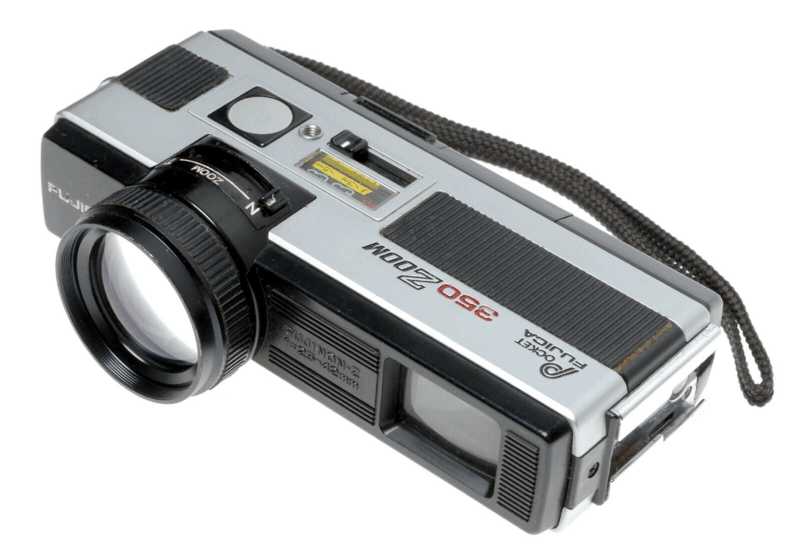
(1976) 25-42mm (f5.6-11.0), seven element, focusing zoom lens. Continuous focusing from 5 ft to infinity. Coupled viewfinder, with parallax marks, zooms along with the main lens. Overall size: 5" long, 2" x 1 1/8 " (at the lens, 2 3/4 " x 1 1/2 "). Accepts 100 or 400 speed film. Like some other models -- NOT the Pocket 330, however -- it has a 3-position aperture setting on the top with weather symbols. It has a mechanical shutter with a single speed of 1/125. It has a hot shoe, tripod and cable release sockets. Listed by Kodak's Eastman Museum as one of the submini cameras that made photographic history.
(1977) Just a Pocket 350 Zoom with a few minor changes/refinements, such as f-stops to f16.
Similar to the Pocket 350 Flash, but it not only came in black, it came in colors!
This is the deluxe edition of the Pocket 300. It has a slightly longer 30mm f5.6 (3/3), 3-zone-focusing lens to 3 feet. A CDS meter provides exposure control of the electronic shutter with speeds of 10 seconds (really!) - 1/400. For flash use, there is a built-in hot shoe, and the shutter it fixed at 1/40. Tripod and cable release sockets. Built-in UV filter. Uses one 544 battery.
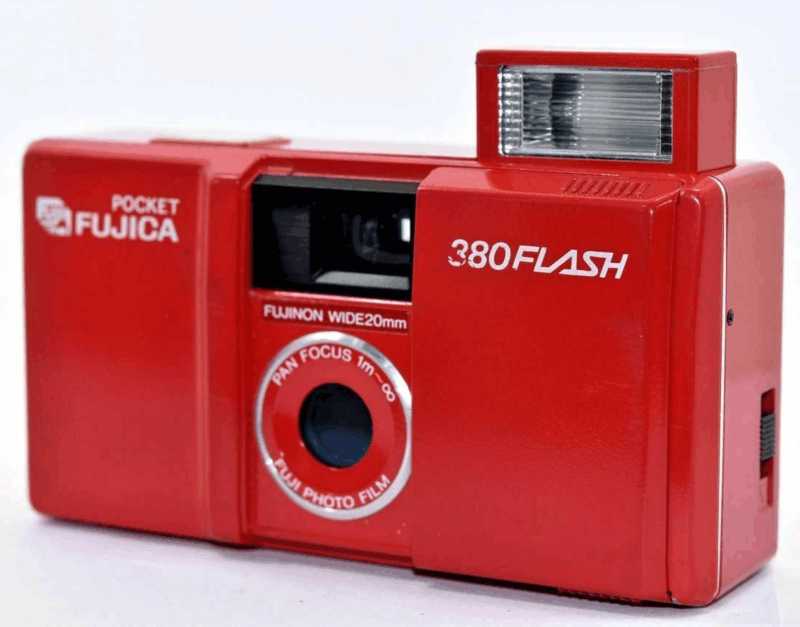
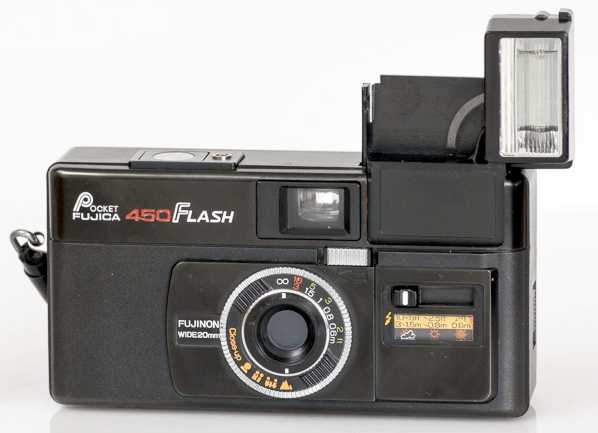
And upgraded version of the Pocket 350 Flash, it has a faster 20mm f4.0 zone-focusing lens with close-focusing to 2 feet. It has a fixed shutter speed of 1/160, but the f-stop can be adjusted by weather symbols on the front. It takes 100 or 400 speed film. Has tripod socket and cable release connection. Built-in flash takes two AA batteries.
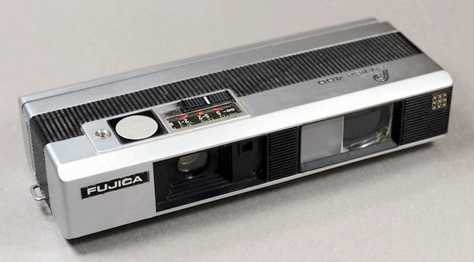
This is the deluxe edition of the Pocket 400 -- with rounded corners! But that's not the important thing. It has a much faster 25mm (f2.8-16.0), (4/3) 3-zone-focusing lens to 3 feet. Electronic shutter with speeds of 4 seconds - 1/500. The CDS meter provides programmed exposure control of both the aperture and shutter. Flash speed of 1/45. Tripod and cable release sockets. Built-in UV filter. Uses two A76 batteries.
And upgraded version of the Pocket 450 Flash, it has the same 20mm f4.0 zone-focusing lens, but there is no need to adjust the aperture by weather symbols on the front -- it does it automatically. On top of that, the CDS meter controls the flash -- if you choose to turn it on. It takes 100 or 400 speed film. Has tripod socket and cable release connection. Built-in flash takes two AA batteries.
This is the deluxe version of the Pocket 500 with the same 25mm (f2.8-16.0), (4/3) lens -- but now with rangefinder focusing. It has the same electronic shutter with speeds of 4 seconds - 1/500. Flash speed of 1/45. The CDS meter provides programmed exposure control, but the Pocket 600 adds back-light compensation when needed -- probably 1.5 f-stops. Tripod and cable release sockets, and hot shoe. It also adds a self timer. Built-in UV filter. Uses two A76 batteries. Available in chrome & black, or all black.
(1980) At first, you might think that the "AW" stands for "All Weather" -- and that would be a nice feature -- but for this camera, it stands for "Auto Winder". The Pocket Flash AW is almost the same as the Pocket 350 Flash -- with a minor change to the flash -- but with an autowinder which advances the film at one frame per second. Also sold as the Chinon 110 Pocket Autowinder.
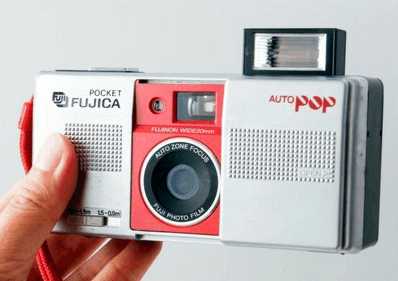
Vertical-style, almost auto-everything camera which when the cover is closed, looks like a radio. Open it up and a two-zone-focus lens appears -- for regular/group or close-up/portrait shots. The CDS meter and the POP-up flash provide exposure control. Came in different colors.
Why not take the innovative 25-42mm zoom lens from the Pocket 330 Zoom, and put it on a vertically styled 110 camera? Why not indeed. This is a merger of the Pocket 330 Zoom and the Pocket 450 Flash cameras.
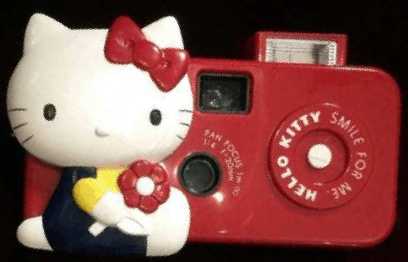
Not to be confused with Fuji's 35mm Hello Kitties, this 110 vertical camera -- with a pop-up flash -- is a bare-bones camera with a fixed-focus 20mm f4 lens. The kitty rotates to cover up the viewfinder and lens!!! It was available in different colors -- just like kitties -- and also as the Sanrio Hello Kitty.
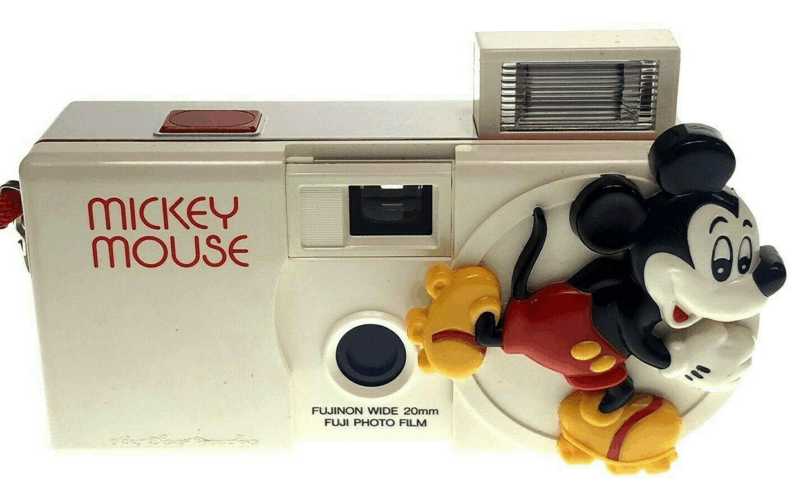
(1983) The Mickey Mouse is a Fujica Pocket 380 in Japan's Disneyland clothing -- actually a white cover -- with Mickey on rollerblades on the front, of course!

To return to the main index for the Sub Club click here.
COPYRIGHT @ 1995-2021 by Joe McGloin. All Rights Reserved.