PENTAX 110 CAMERAS
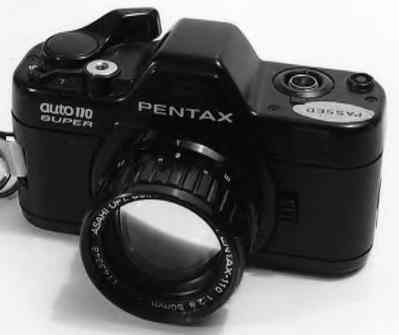
Most camera manufacturers made 110 cameras. Pentax was just one of them. But what sets Pentax apart is that they only made ONE 110 camera. Many consider the Pentax 110 the best 110 camera ever made.
All of these cameras can be reloaded with 16mm film (in 110 cassettes, of course) -- but it depends on the model. The origianl Auto 110 models can use the reloaded cassettes without any modiofications to the camera or cassette. And reloaded cassettes can be used in the Auto 110 SUPER if a small change is made to the cassette. Specifically, the SUPER has a tiny cassette sensor along the edge of the film plane. If a notch is cut in the cassette edge to avoid pushing the sensor, the camera will operate normally.
If you are able to provide more accurate information than is listed here, please contact us.
(1978) Top-rated 110
system that looked and operates like a tiny 35mm SLR system. The Auto 110
is a true SLR with interchangeable lenses, motor drives, flash units,
close-up lenses, filters, and much more. The fully automatic exposure
system is truly a wonder. Both aperture and shutter speed settings
are programmed by the camera in accordancce with the lighting situation.
By ingeniously combining the shutter with the aperture blades, Pentax engineers
created a system that's amazingly sensitive and accurate, yet simple to use.
Shutter speeds vary from 1 second to 1/750. Apertures run from
f2.8 to f13.5 -- on all lenses (Since the aperture is really in the camera
body, they couldn't make any lenses that didn't allow for f2.8). As amazing
as it may sound the image in the viewfinder rivals that of even the best
35mm SLRs, in terms of contrast, size, brightness, and clarity. Inside the
SLR viewfinder, you'll find a surprisingly large split-image finder surrounded
by a matte glass field. You'll also see an LED in the lower right-hand
corner to provide exposure information. Green means that the picture
can be taken hand-held. Yellow means use a flash or a tripod as the
shutter will be 1/30 or slower. The camera weighted just 5.6 ounces
and could fit in a shirt pocket with room for a couple of lenses, as well.
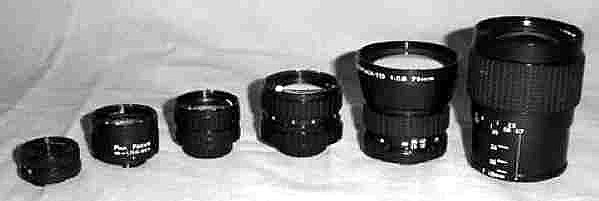
The original camera lenses were:
24mm (f2.8) 25.5mm thread (6/5) -- equivalent to a 50mm in 35mm full frame
format
50mm (f2.8) 37.5mm thread (5/5) -- equivalent to a 100mm in 35mm full frame
format
18mm (f2.8) 30.5mm thread (6/6) -- equivalent to a 35mm in 35mm full frame
format
In 1981 three additional lenses were added:
18mm pan-focus -- Fixed focus lens -- everything was in focus from infinity
to 6 feet. Equivalent to a 35mm in 35mm full frame format
70mm (f2.8) 49mm thread -- equivalent to a 150mm in 35mm full frame format
20-40mm zoom (f2.8) 49mm thread -- equivalent to a 40-80mm zoom in 35mm full
frame format
A special motor winder was available that would deliver over 1,200 exposures
on 2 AA batteries. Later, the Winder II auto winder appeared. It
has slightly more robust tabs on the battery door than the model I. Special
dedicated flash units were available, such as the AF 130 P and AF 100
P. Various accessories were available, such as teleconverters, close-up lenses,
filters, cases, pouches, lens hoods, eye piece correction lenses and
more. The original price for the entire system in 1978 was $500 -- compare
that to the cost of the average 110 camera of the time!!! Uses two
A76 batteries. The first bodies produced had "ASAHI" as well as "PENTAX"
logos painted in white on the pentaprism front. Only about 70,000 of these
bodies were made. The white Asahi's are also referred to as "Pan Heads",
because the screws on the body that straddle the viewfinder are little slotted
"pan head" screws.
(1979) In less than a year, Pentax stopped painting in the "ASAHI" on the Auto 110. All camera features remained the same. Very shortly after they stopped painting in the "ASAHI" they also changed those pan head screws to philips flat heads. So there are some very rare Black Pan Heads out there.
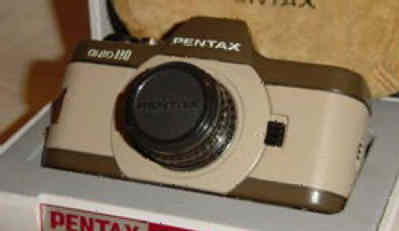
(1979) A more unusual variant is the brown model, called the "Safari". It had a dark-brown plastic with a light brown leather. All camera features remained the same. This variant was not available for sale. It was more of a corporate gift than an actual sale item, so is harder to find.
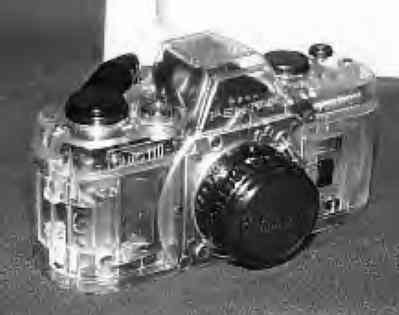
(1979) This variant was not available for sale, but was used as a demonstration model in camera shops. Some have made their way to the consumer market. Several variations of this model were sold over the years and it can beome a collector's dream all to itself. It was a fully functioning camera in terms of the mechanics, but the transparent body means that picture taking was not the intent, of course. It has been seen in both the "pan head" style and "philip head" style, and some of the latest models had an opaque film chamber to allow for actual picture taking with the opaque 110 cassette. Talk about an expensive 110 keychain camera! All camera features remained the same as for the original

To return to the main index for the Sub Club click here.
COPYRIGHT @ 1995-2022 by Joe McGloin. All Rights Reserved.