ILFORD HALF-FRAME CAMERAS
If you are able to provide more accurate information than is listed here, please contact us.
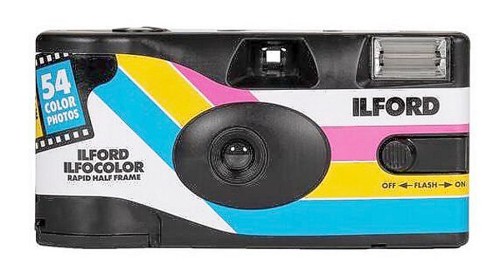
Starting in 2023, this camera was sold as a disposable camera, pre-loaded with Ilford 400 ISO color negative film yielding 54 exposures out of what would usually be a 27-exposure roll. Exposures are in portrait format with the camera held conventionally (the Ilfocolor Half Frame is easier for viewing photos on portrait-oriented mobile devices). The 31mm lens has a fixed aperture of f11 and will keep everything from 3 feet to infinity in sharp focus. A built-in flash (with an ON/OFF switch & flash ready-light) compliments the 1/125s shutter speed for low-light situations. The camera is powered by a single AAA battery, which comes included. It is the only half-frame disposable (the others were full-frame and 110 format), and with a little effort it can be reloaded -- it has a normal 35mm cassette inside. Reloading a disposable camera is not everyone's "cup of tea", but instructions on re-loading can be found on-line.
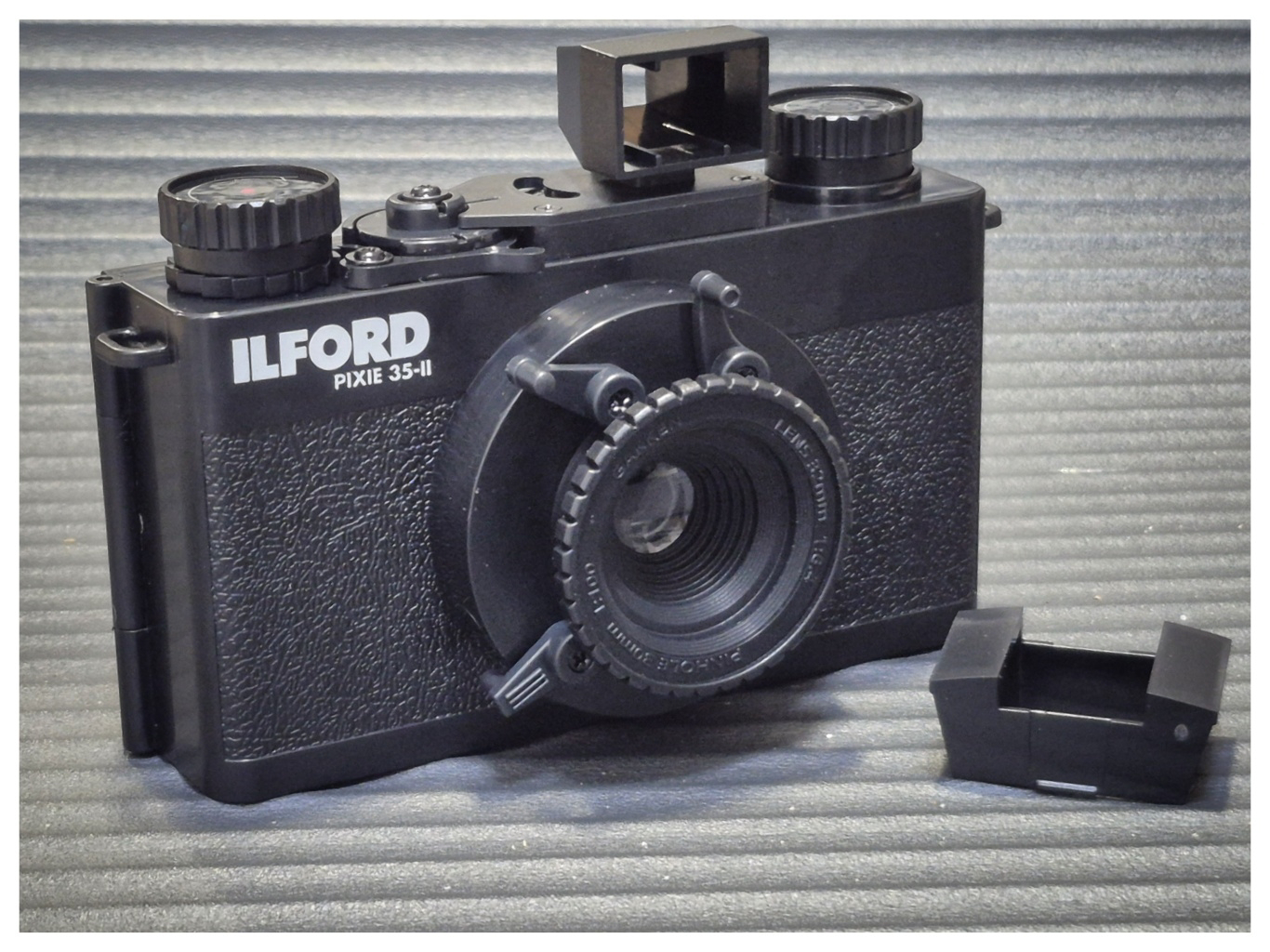
(2026) This unique camera is made by Gakken, and is hard to describe. It's a simple camera, but not simple to use. If you want to get into Lo-Fi, this is it. The only question is How-Lo? Ilford says they are resurrecting the 127 Pixie from the 1960's in a 35mm camera. It has a 32mm f6.4 focusing lens with f-stops at f6.4, f16 and f100. The single-element, plastic lens is removable to create a 30mm pinhole. There are marks in meters on the side of the lens for 0.3 (one foot), 0.5, 1, 2, and infinity. There are two speeds -- 1/100 and B -- yes, it has a tripod socket. The shutter is manually cocked, so multiple exposures are easy. The format is either 24x36mm or 18x24mm -- using a slip-in mask. (That makes a 48mm lens) There is a switch on the top that sets the film counter for full-frame or half-frame. As with 127 film, you advance the film manually but turning a knob and watching the film counter to stop the advance. There is a viewfinder on the top, for both formats. There is no PC connection, like with the Diana Baby 110, but using the B setting allows for some hand-held, manual flash use -- i.e., flash "painting". If you want Lo-Fi, this is it. Wide open, the only thing that will be recognizable in a print is what it in the center of the image. Everything else is just blurred out. Using f16 helps a lot, and f100 is really "not bad". And then there is the Pinhole without the lens. And, of course, using the camera in half-frame mode cuts out the extreme blur on the edges. That's all up to you. You can't change formats mid roll, but you can make long panoramas if you keep good notes and advance the film carefully. Ilford suggests ISO 400, but ISO 100 is great for sunny situations.
To return to the main index for the Sub Club click here.
COPYRIGHT @ 1995-2026 by Joe McGloin. All Rights Reserved.