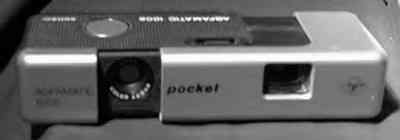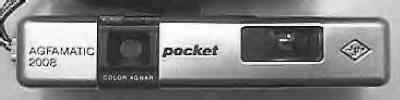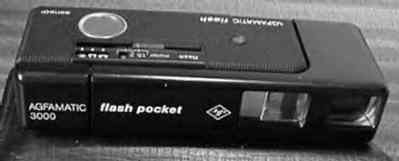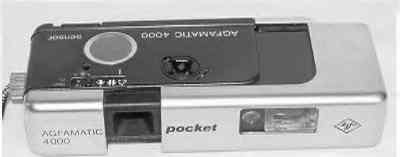
Agfa was right on Kodak's heels as soon as the first 110 cameras were announced
-- making 110 cameras AND 110 film -- starting in 1973. They made an incredible
number of 110 cameras, from bare-bones models to top-of-the-line -- although
they never went "all out" with SUPER models, like Minolta, Pentax, Fuji,
etc. Many models used the push-pull design of the Minox/Minolta to
advance the film -- this made the camera more compact when not in use.
Many of their cameras have a "Sensor" button, which is nothing more
than a SOFTer shutter release button -- in an attempt to minimize the inherent
movement of the 110 camera when pressing the shutter. On most (all?)
of their 110 cameras, the hand strap could be removed, and the socket could
be used as a standard tripod socket -- nice touch.
(1978) This is basically an updated version of the Agfamatic 1000 (of
1974) -- but in chrome & black, instead of all black. A conventional,
no bones, 110 camera with a slightly slower, 26mm f11, fixed-focus lens.
This model accepts flip-flash instead of the earlier Magi-cubes of the 1000.
It has the same fixed shutter speed of 1/100 which switches to 1/50 when
a flip-flash is attached. More importantly, unlike the Agfamatic 1000,
the 508 actually uses the Minox/Minolta push/pull feature to advance the
film and cock the shutter. The BIG difference is that this one takes
100 & 400 speed film -- unlike its predecessor. The 508 was later
resurrected in 1981, and sold as the Agfa mini (below). Why? Who
knows?
(1978) This model, the first in the 901 series, shows that a lot of features can be packed into a small camera. It not only has a CdS meter, but it has a motor drive -- and it needs two AAA batteries to power all this stuff (the add-on flash needs its own batteries). A meter readout in the viewfinder indicates the correct shutter speed -- which is manually selected on the top of the camera. Uses two AAA batteries. Available in an all black model or all silver, it was also made in a transparent model -- for store display purposes. All of the 901 camera could use a FlipFlash, but they could also use special electronic flashes from Agfa -- the Agfamatic Lux 901 and the Agfamatic Lux 901 Mini -- which used the FlipFlash socket instead of a typical hot shoe, and set the shutter speed at 1/50.
(1979) The next year, Agfa produced a similar 901 motor model but WITHOUT the CDS meter. It looks like any other 110 camera, but it has a motor-drive built in. Otherwise, it's pretty basic. A weather-icon switch changes the shutter speed from 1/100 to 1/50. Accepts flip-flash. It is available in many special edition and promotional styles. Similar to the Agfa Tramp #2. Uses two AAA batteries.
(1979) Same as the 901, but with four weather settings instead of just two. Uses two AAA batteries.
(1982) That's "motory", not "motor". Similar to the 901S, but with a CDS meter and automatic exposure control. Uses two AAA batteries.
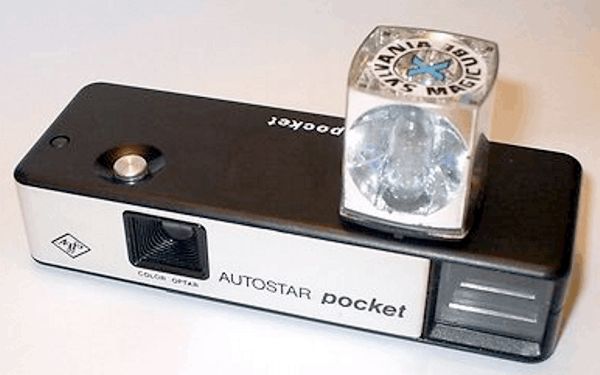
(1974) A conventional 110 camera with a twist. It has a fixed-focus "Color Agnar" 26mm (f9.5) lens. It has a mechanical, fixed shutter speed of 1/100 which switches to 1/50 when a flashcube is inserted. It is triggered by a circular, orange, resilient pad which Agfa insisted on referring to as the 'sensor'. It has the push-pull style of the Minolta 16 except that the push-pull does not advance the film -- it just covers everything up. It was resurrected four years later as the Agfamatic 508 which actually advanced the film and cocked the shutter when you closed it. Designed for 100 ASA film only.
(1978) Four years later, Agfa produced the Agfamatic 100S. It's the same thing as the original, but the exterior is aluminum, suggesting "silver". Maybe that's where the "S" comes from..
(1978) It's a 1000 Pocket with three changes. First, the body style is much more rounded. Also, it accepts flip-flash instead of flash cubes. Most importantly, the film is now advanced and shutter cocked "Minox-style" by pushing the end of the camera in and out.
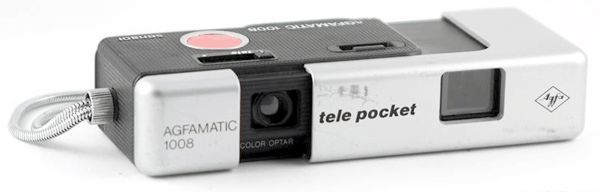
It's the same as the 1008 Pocket, but it has a slide-in accessory tele lens built-in to create a 43mm optic. The viewfinder changes as well.
(1973) "Deluxe" version of the 1000 pocket. The lens is a fixed-focus "Color Agnar" 26mm (f9.5). The instructions claim a focus range from 4 feet to infinity. It has a mechanical shutter with switchable speeds of 1/100 sec. and 1/50 sec. The shutter is mounted externally, in front of the lens. The speeds are marked by 'idiot' symbols - Sun for 1/100 sec., Cloud for 1/50. Designed for 100 ASA film only. Flash-cube socket - inserting a flash-cube switches the shutter speed to 1/50 sec. Tripod socket. The film is advanced Minox-style by pushing the end of the camera in and out - the moving body section also extends around the front to protect the lens & viewfinder. The only other features are the shutter and speed switch on the top panel, and a slide-lock to hold the body closed when not in use. The body is mainly black plastic, with a few metal components both internally and externally - the body end & cover section is in brushed aluminium, with a couple of extra aluminium trims on the main body. Several accessories were available, such as a Wrist-chain, Flash-cube extender post, Soft case, Natarix Agfamatic close-up lens, and Agfamatic pocket Lux electronic flash unit. One of the first 110 cameras from suppliers other than Kodak, the Agfamatic 2000 is a basic manual point & shoot device, with no electronics or automation of any kind. Aesthetically, it's a homage to the Minox, with some styling cues (notably the rounded aluminium front cover & film advance) clearly lifted from the classic Minox B and C. Despite its very ordinary internals, there's enough metal in the body to make it feel encouragingly substantial.
Similar to the 2000, but with a built-in flash. Slightly longer body as a result. Uses two AAA batteries.
Same as the 2000, but accepts flip-flash instead of flashcubes.
Similar to the 2008, but with an accessory tele lens built-in (43mm). Has a 26mm f11.0 fixed-focus lens with an accessory 43mm f11.0 telephoto. Non-flash speed of 1/100 sec. When Flip-flash is inserted it sets the speed to 1/50. Minox-style by pushing the end of the camera in and out - the moving body section also extends around the front to protect the lens & viewfinder.
A deluxe version of the 2000 pocket, it has a faster lens and more exposure flexibility. The lens is now an f6.3 26mm lens -- still fixed-focus -- and the camera features four weather symbols instead of the original two.
Same as the 2000 flash pocket, but with a faster lens (f4). Uses two AAA batteries.
Same as the 3000, but accepts flip-flash instead of flashcubes.
An updated version of the 3000 with a CDS meter. The lens says "Color Apotar" and the shutter speeds are marked not with clouds, but with what appears to be a campfire flame, two people, one person, then the 'bump' to slide the switch, and in blue has flash markings of 4/2/1.2 m etc. LED's in the viewfinder indicate a correct exposure or the need for a flash. Uses two 625 batteries.
Same as the 3000 flash pocket, but with automatic exposure control. Uses two AAA batteries.
Similar to the 4000, but accepts flip-flash instead of flashcubes. Has a 26mm f6.3 focusing lens. Close focus to 3 feet. Built-in CDS meter gives automatic exposure control by setting the shutter speed -- from 30 seconds to 1/500. Film speeds from ISO 25 to 400. Uses two 625 batteries.
Same as the 4008, but with an accessory tele lens built-in. Uses two 625 batteries.
Similar to the 4008 flash pocket, but with extra close-focusing capability. Has a 26mm f2.7 - f16.0 focusing lens. Close focusing to 10 inches. The viewfinder has automatic parallax correction to 20 inches and parallax marks in the viefinder down to 10 inches. Low battery and long exposure warnings in the viewfinder. Built-in CDS meter gives automatic exposure control by setting the shutter speed -- from 15 seconds to 1/1000 -- and the f-stop. Cable release connection and tripod socket. Uses two 625 batteries.
Deluxe version of the 5008 makro pocket. Uses two 625 batteries.
(1976) There's nothing stellar about this conventional, simple, mostly plastic, 110 camera -- Agfa's cheapest 110 -- which was made in Brazil (like a lot of Kodak's 110 cameras) and India. It has a 26mm f11 fixed-focus lens -- with DOF from four feet to infinity -- and it accepts flashcubes. The shutter speed of 1/100 switches to 1/50 when a flashcube is inserted. It's the only Agfa 110 camera that lacks a "Sensor" shutter release button, and a removable wrist strap (for using a tripod).
A conventional 110 camera with dual lenses. 26mm and 43mm(f11) fixed-focus switchable lenses. Accepts flip-flash. Fixed shutter speed of 1/100 switches to 1/50 when a flip-flash is attached. Minox-style push-pull design.
A conventional 110 camera. 26mm (f9.5) fixed-focus lens. Accepts flip-flash. Fixed shutter speed of 1/100 switches to 1/50 when a flip-flash is attached. Minox-style push-pull design.
Same as Colour King 200 with dual lens setup. Minox-style push-pull design.
Deluxe model in the Colour King line. Automatic exposure control. Accepts flip-flash. Minox-style push-pull design.
Similar to the Agfamatic 2000 flash pocket. Minox-style push-pull design.
Similar to the Agfamatic 1008 pocket. Accepts flip-flash. Minox-style push-pull design.
(1981) It's the same as the Agfamatic 508 Pocket, resurrected three years later with a new name.
Uses one 625 batteries.
Uses three 625 batteries.
Uses three 625 batteries.
Predecessor to the Agfamatic 5008 makro pocket. Accepts flashcubes. Minox-style push-pull design. Uses three 625 batteries.
Uses three 625 batteries.
Predecessor to the Agfamatic 6008 makro pocket. Accepts flashcubes. Minox-style push-pull design. Uses three 625 batteries.
Uses three 625 batteries.
Similar to the Agfamatic 1008 pocket. Accepts flip-flash. Minox-style push-pull design. Came in various colors.
Similar to the Agfamatic 901 motor. BUT in a kit
Not to be confused with the Agfa Autostar, it is similar to the Agfamatic 901 SE motory.
A compact 110 camera with an electric motor drive that works in either single frame or in rapid sequence. It has a fixed-focus Color Apotar lens and aperture control of the 4 blade diaphragm by 4 symbols from cloudy to sun over water. Similar to the Agfamatic 901.
(1982) The main difference is that this model says "No 2" on the TOP of the camera.
Similar to the Agfamatic 3000 flash pocket.

To return to the main index for the Sub Club click here.
COPYRIGHT @ 1995-2023 by Joe McGloin. All Rights Reserved.