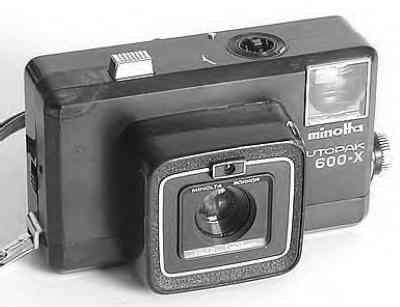
MINOLTA 126 CAMERAS
126 cameras have come and gone. The original intent was to make a 35mm camera with drop-in film loading.
But most 126 cameras were of poor quailty and they never became popular since the results were less than
the SLIGHTLY harder-to-load 35mm cameras. Minolta's 126 cameras, however, were star performers. And
the good news is that you can still buy 126 cassettes today, so you can still use these cameras.
This list is inaccurate and incomplete. If you are able to provide more accurate information than is listed here, please contact us.
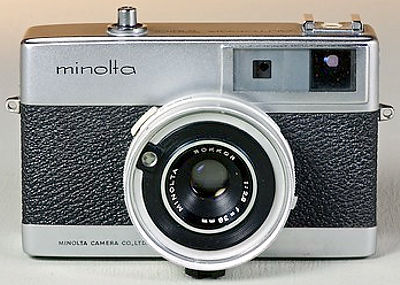
(1966) Kodak introduced the Instamatic film format and camera in 1963. Minolta's first 126 camera was a full-featured camera (unlike most 126 cameras), and was based on their Minolta Rapid 24 rangefinder camera of 1965, that produced 24x24mm images on 35mm -- using Agfa RAPID cassettes. The Autopak 700 looked, operated and felt like a standard 35mm rangefinder. And this is how Kodak marketed the 126 camera to the public. They stated that these cameras would have the quality of a 35mm camera with drop-in-film ease. In fact most 126 cameras didn't have this quality, due to cheap lenses -- one of the reasons that the 126 format died out. They also lacked the features of most 35mm cameras -- one of the reasons they were so cheap. And so Minolta's top-of-the-line 126 camera was a commercial flop. It was a quality shooter, for sure, but it was far too pricey when compared to the typical $10 126 cameras on the market at that time. It has a fast, 38mm f2.8, rangefinder-coupled, focusing lens with four elements in three groups. It had automatic, semi-automatic, and manual exposure modes with a behind-the-filter CDS meter displaying an EV number in the viewfinder. Shutter speeds can be selected from 1/30-1/250 (plus B -- ever think about a time exposure with a 126 camera?), and apertures can be set from f2.8 to f22 in manual exposure mode. In auto-exposure mode, the exposure varies together from f2.8 at 1/30s to f22 at 1/250s. In semi-automatic mode, the EV number in the viewfinder can be transfered to a small window on the lens by turning either the shutter speed and/or f-stop ring. And of course, a hot shoe, cable release connection, PC contact, and tripod socket are included. It was probably the only 126 camera to offer all of these features. But Minolta learned its lesson -- you can't sell expensive 126 cameras! As a result, the Autopak 700 was very different from all of the later Minolta 126 cameras. It uses one 625 battery.
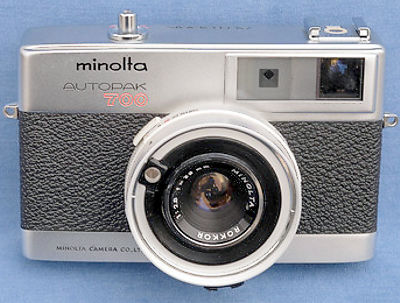
(1970?) At some point, Minolta made a change to the original Autopak 700. All the features are the same, but the "AUTOPAK 700" was moved from the top of the camera to the front -- and the "700" is now in red.

(1966) The next year Minolta redesigned their 126 camera and boy, what a change! It still had the same fast 38mm (f2.8) lens with four elements in three groups, but now it is a zone-focusing lens and it is not rangefinder-coupled. In addition, the manual settings were dropped and the shutter speeds set by a selenium meter -- not the more expensive CDS meter. It was designed to be used with a flash cube always in place. The meter determined whether it needed to be fired or not. The 500 uses two AAA batteries -- for the flash cube only -- but the camera will work correctly without them.
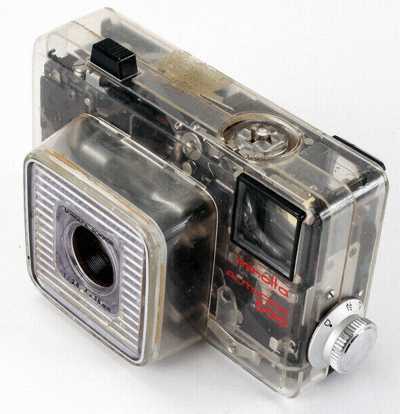
Demonstration Model on the front.
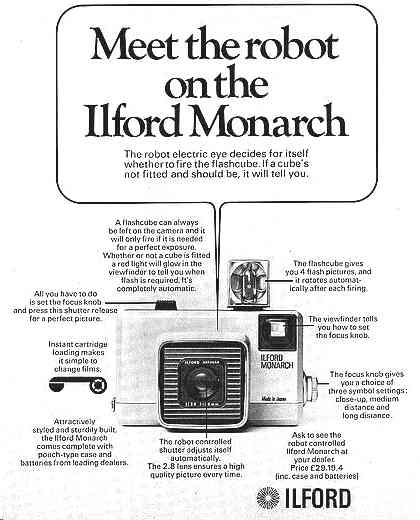
Same as the Minolta Autopak 500 with a different nameplate. It was available in different color "shades", such as white, light gray, and pale pink.
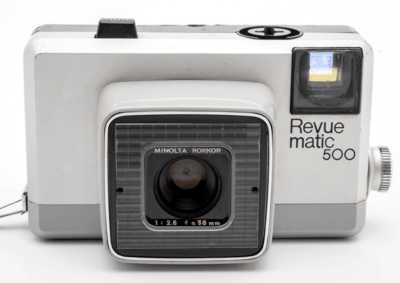
Same as the Minolta Autopak 500 with a different nameplate.
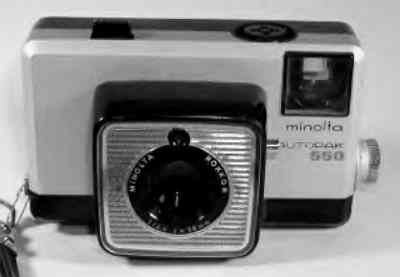
(1969) An updated version of the Autopak 500. It had the same 38mm (f2.8), with four elements in three groups, zone-focusing lens, but now the aperture is set by a CDS meter. Single speed of 1/90. Uses two AAA batteries -- for the flash cube only. The camera will work correctly without them.
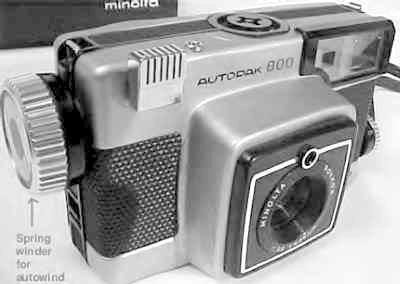
(1969) Top-of-the-line 126 camera. Features include a Rokkor 38mm f2.8 lens, with four elements in three groups, with rangefinder focusing, electronic aperture control, flash cube connection, manual/automatic flash, and a spring motor drive -- capable of about 1 fps. Speeds of 1/45 (for the Flassh Cube), and 1/90 (withput). A CDS meter provides programmed exposure control of the aperture. It uses one 625 for the meter, and two 825 batteries for the aperture control.
(1969) One of Minolta's forays into the 126 market was a collaboration with the 3M (Minnesota Mining and Manufacturing) Corporation. In the 1960's, 3M decided to climb out of the mines, and make some money in the photographic arena. They would produce cameras of various formats, as well as photographic film in various formats. To help accomplish this, they purchased the Revere Camera Company which was well-known in the US, especially for its movie cameras. In addition, they purchased the Ferriana Camera Company which was well-known in Europe as a photographic film, paper and camera maker. In the late 1960's, when Ferrania was making some 126 cameras, 3M had Ferrania collaborate with Minolta on some new 126 cameras. These would be designed to Ferrania's specifications, but manufactured by Minolta. There were at least three of these cameras, which look very similar to the other 126 Ferrania cameras that Ferriana made -- which had names such as Ferrania 3M 1014 and Ferriana 3M 1020. But we know which 3M 126 cameras were made by Minolta, not only because they had lenses that are marked "ROKKOR", but the cameras are stamped "MADE IN JAPAN" on the bottom. The relationship was short-lived, but these "Minolta" cameras are still easy to find -- often in the original box..
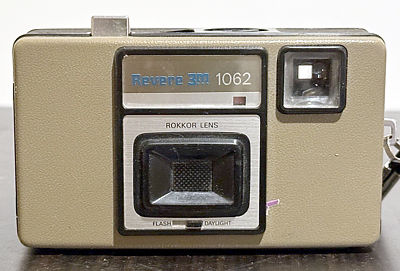
The first was the Revere 3M 1062. This model was the most basic, with only one exposure control. The 34mm, 3/3, fixed-focus lens on this Revere camera has two f-stop settings, controlled by a small switch on the front, under the lens. Depth of field is, at a minimum, four feet to infinity. The DAYLIGHT setting is f8 at 1/90s, while the FLASH setting is f22 at 1/45s -- which requires a Flash Cube powered by two AAA batteries. They also power a photocell, which illuminates a small RED light when a Flash Cube is needed. Although made by Minolta, it was never sold as a Minolta camera.
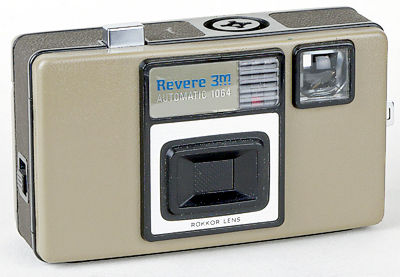
(1969) Next up the ladder is the Revere 3M Automatic 1064. It looks almost the same as the 1062, but it has a slightly longer 38mm, fixed-focus f8 lens. The main difference is that a CdS photocell controls the aperture with a shutter speed of 1/90 -- hence the "AUTOMATIC" designation. For low light situations, Flash Cubes fix the shutter speed at 1/45s. Although made by Minolta, it was never sold as a Minolta camera.
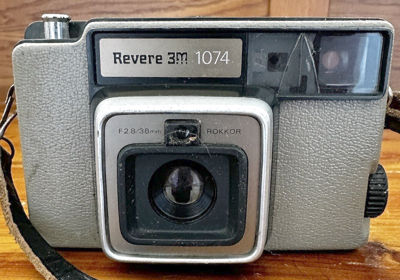
(1969) Looking like an Autopak 800 -- it should -- it was the top-of-the-line Revere 3M camera from Minolta. It had the main features of the Autopak 800 -- a much faster 38mm f2.8, 4/3 focusing lens -- and a rangefinder, focusing to 3.3 feet. The focusing was controlled by a dial on the left-hand end of the camera -- marked in feet and meters -- which also displays distance icons in the viewfinder. It also has the same 1/90s shutter speed with the aperture controlled by a CdS meter, and a shutter speed of 1/45 when a Flash Cube was inserted. A red light in the viewfinder indicates the need for a Flash Cube. It requires a 625 battery for the meter, and a PX23 for the Flash Cube. Although made by Minolta, it was never sold as a Minolta camera.
(1971) 38mm (f2.8), with four elements in three groups, zone-focusing lens. Dual speeds of 1/45 (for flash) and 1/90. Aperture set by CDS meter from f2.8 - 22. Close focusing to four feet. Takes Magicubes -- which are controlled by the meter. Uses a 640 battery.

(1973) The last Minolta 126 camera had a 34mm (f8), fixed-focus lens in a very stylish, compact package. Dual speeds of 1/45 (for flash) and 1/90. Aperture set by selenium meter from f8 - 27. Takes Magicubes. The shutter release could be retracted to prevent accidental exposure.
We didin't want to do this, but since other websites have been stealing our stuff, we have no alternative but
to state:
COPYRIGHT@1995-2021 by Joe McGloin.
All Rights Reserved. The material on this website is protected by US Federal copyright laws. It cannot be copied
or used in any manner without specific approval from the owner.