KONICA HALF FRAME CAMERAS
Half-framers know Konica best for its Autoreflex series of camera. These were full-frame (and full-sized) 35mm SLRs that could be set to take half-frame sized images with a built-in mask. But Konica made several cameras that were true half-frame cameras as well. The Autoreflex cameras are not listed since they are not true half-frame cameras.
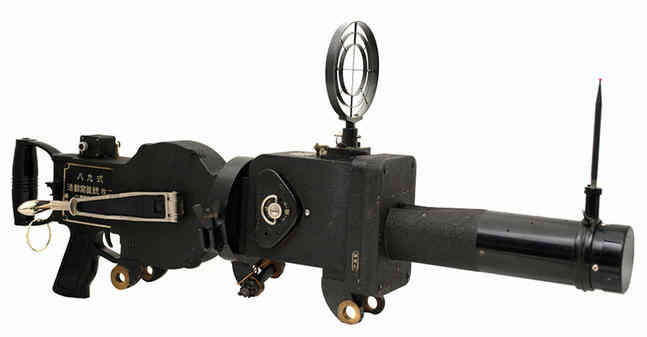
(1933) Konica was originally known as Konishi and Co. -- one of the oldest camera manufacturers in Japan. In 1933, they made a target-practice camera that was used for military purposes. (Japan was in the middle of an enormous military build-up at the time, which would end with World War II. Many other photographic companies also produced military items at that time. The Model 89 was shaped like a machine gun and had two lenses -- one that was pointed at the target and the other was pointed at a clock. The resulting negatives would determine if the target was hit and at what time. The target-lens was a 250mm (f4.5) fixed-focus lens. Single speed of 1/300. The motor-drive took ten pictures per second -- proving, once again, that the military gets all the good toys first!
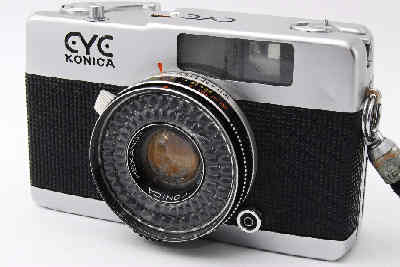
(1966) Konica was late getting into the REAL half-frame market (the Konica Auto Reflex was a full-sized 35mm SLR that could be set for full-frame or half-frame operation), but when they did, they made a very nice half frame camera. The EYE has a FAST 30mm (f1.9-16) focusing lens surrounded by a selenium meter. Focusing runs from infinity to 3.5 feet and can be set by distance "eye"-cons in the viewfinder. The meter sets the aperture and shutter speed automatically and displays the set shutter speed in the viewfinder. The built-in selenium meter sets the shutter speed and the f-stop in a programmed exposure mode. At 1/30 the f-stop is f1.9; at 1/800 the f-stop is f16. For flash use, the apertures can be set manually with a 1/30 shutter. There is also a B setting for the shutter which sets the aperture at f1.9 -- great for night shots. ISO film speed from 10 - 400. Shutter speeds from 1/30 - 1/800. In low light conditions, a red flag pops up over the shutter speed scale to prevent a bad exposure. Flash PC connection, but for some reason, no flash shoe. Tripod socket, cable release connection, 46mm filter thread. Sometimes called the Konica CYC since the middle section of each "E" in "EYE" are dots instead of dashes -- to simulate eyes. The dots are easy to miss and make the "EYE" look like "CYC" instead. Also marketed as the Wards EYE -- with a couple of changes. The Soviets liked the design of the EYE so much they copied it when they made the Fed Micron -- with a couple of changes.
It's just a "misspelling" of the Konica EYE.
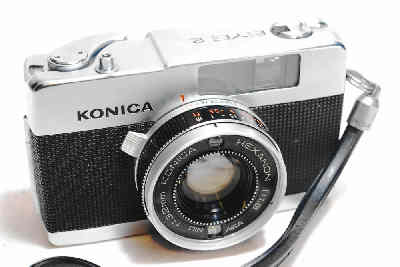
(1967) Just a year later, Konica came out with this updated version of the Konica EYE, but is less frequently seen. It has a slightly faster 32mm (f1.8) focusing lens. The features and operation are the same as its predecessor, but it now sports a more-sensitive, CDS meter. The film speed window has been moved from the top of the camera to the front of the lens. It still lacks a built-in flash shoe which is surprising given that the Wards EYE had one. The only other noticable change it that the "CYC/EYE" is no longer on the front. It now is stamped "EYE 2" on the top, without the confusing "CYC". There was never a Wards EYE 2, and the Ruskies, as is typical, made their own changes to their FED Micron.
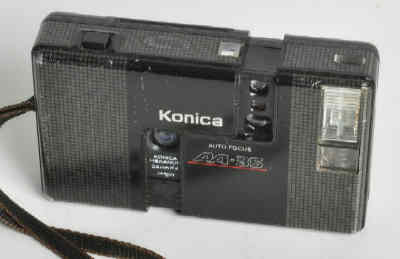
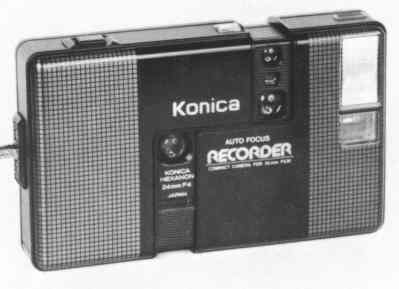
(1985) Quite a camera at the time, with many innovative features. It had a 24mm (f4.0-16) auto-focus lens, focusing to 3 feet. Built-in CDS meter automatically sets shutter speed (1/60 - 1/250) and aperture, in a programmed-exposure system. Although the focus and exposure were strictly automatic, these limitations are somewhat overcome by the other features, such as a built-in motor-drive, auto-exposure, and flash. First drop-in the film. It ran vertically, so the pictures come out horizontal, unlike most half-frame cameras. Then set the film speed (ISO 100 - 400) and you are set to go. The camera focuses the lens, then exposes the film, then advances the film. A RED/GREEN LED in the viewfinder tells you whether the exposure was correct or not. All this in a very thin, attractive body. The camera had the same shape of the disc cameras of the time -- its's so thin you assume that it CAN'T be 35mm! And it had a built-in sliding case to keep everything protected -- well, almost everything -- not the flash and the viewfinder. When the roll is done, flip the switch on the bottom of the camera and the motor rewinds the film into the cassette. The camera came in a variety of colors, such as red, grey flannel, etc.. No tripod socket, flash shoe, PC contact, filter thread or cable release socket. But it DID have a wrist strap! Takes two AA batteries that operate the flash, the meter and the motor drive. It is the same as the Konica Recorder.
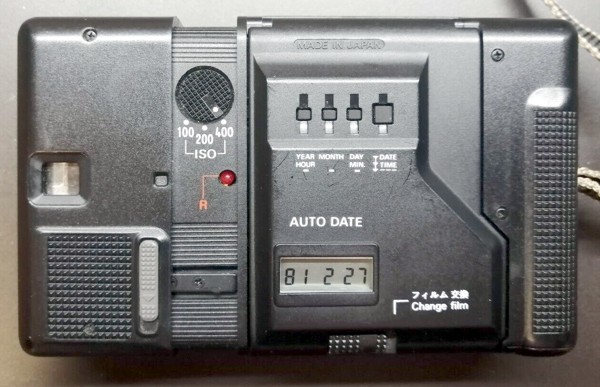
(1985) Same as the Konica AA-35, but has an adjustable time/date back -- and is marked "AURO DATE" on the front.
(1985) Same as the Konica AA-35.
(1985) Same as the Konica AA-35, but has an adjustable time/date back -- and is marked "AURO DATE" on the front.
COPYRIGHT @ 1995-2023 by Joe McGloin. All Rights Reserved.