FUJI HALF FRAME CAMERAS
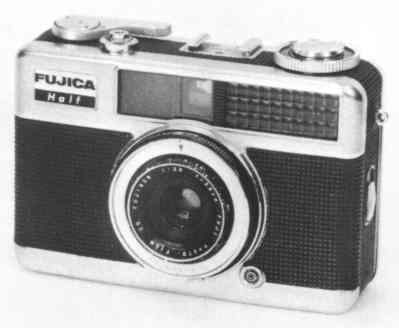
(1963) Fuji jumped into the half-frame war the same year that Canon did. In fact, their first half-frame -- the Fuji Half -- had a camera body that looked a lot like the Canon Demi. The features were similar as well. It had automatic exposure with selenium meter next to the viewfinder. This would set both the shutter speed and aperture together from 1/250 at f22 down to 1/30 at f2.8. One nice feature is the combined aperture/shutter speed scale readout in the viewfinder. But it also has complete manual exposure control. In manual mode, both the aperture and the shutter speed could be set individually -- unlike the Demi. The f-stop scale is on the top of the lens (with a "A" for auto mode) while the shutter speed scale is on the bottom of the lens (with a "A" for auto mode or flash use) For flash use, you can switch from the automatic setting to an f-stop scale. This sets the shutter speed to 1/30 and you can select the f-stop, based on the flash GN and distance to the subject. It has a 28mm (f2.8 - 22) focusing lens, close focusing to two feet. The distance scale is only marked in feet and it has detents at the GROUP and PORTRAIT distance. Speeds are 1/30 - 1/250 in a trap needle system (in auto mose) which you can use as an AE lock by pressing the shutter release button half-way. In manual mode the speeds are B, 1/30, 1/60, 1/125, and 1/300. It has a locking self-timer, cold shoe for flash with a PC connection, tripod socket and cable release socket. Film speeds of 12 to 200. A definite winner, feature-wise and quality-wise.
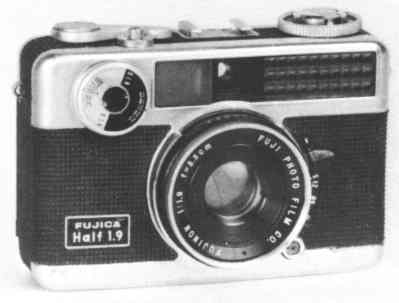
(1967) Same body as the Fuji Half. An improved version of the Fuji Half, this is a full-featured half-frame. It has a 33mm (f1.9) manually-focusing lens (to 36 inches). The film speed is dialed into the selenium meter (ISO 25-400) and a match needle system in the viewfinder indicates the correct exposure by selecting the correct shutter speed (1/8 - 1/500, plus B) and aperture (f1.9 - 22) combination. Both the aperture and the shutter speed selected are visible in the viewfinder -- in addition to distance setting information. The camera also has a cold shoe with PC connector, self-timer, film reminder dial, cable release socket and tripod socket. Nowadays, it seems like a big camera, but at the time they packed a lot of features into a small body. It does not have a spring drive.
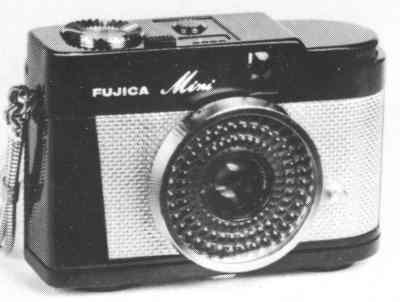
(1964) Perhaps the smallest half-frame camera (3.5"x2.5"x1.5") it has a 25mm (f2.8) fixed-focus lens. Single speed of 1/200. Once the film speed is dialed in (ISO 25-200), the correct aperture is selected by turning a lever in a match-needle system. The camera's built-in selenium meter displays the exposure information in a tiny window on the top of the camera. The film is advanced with a turn of the camera while the thumb and index finger hold one end of the camera -- very fast and convenient. Available in black and chrome or all black bodies. Built-in UV filter. It is often reported that the Mini used special cassettes, but this is not the case. It uses regular 35mm cassettes.
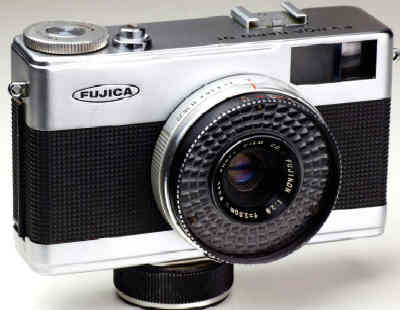
(1966) The Rapid D1 is similar to the earlier Fuji Drive, but it was designed for Rapid cassettes. As a result, the body is slightly wider. The lens is now a wider 28mm f2.8 lens with f-stops to f22. Focusing is from infinity to 2 feet with click stops for Group and Portrait. It was designed as an automatic programmed exposure camera, but the f-stops and aperture can be set manually, if desired. Speeds are B, 1/30 - 1/300. Spring motor drive. The selenium cell now surrounds the lens and results in a 52mm filter thread size. Has tripod socket, cabkle release connection, cold flash shoe and PC contact.
(1985) Another dual lens half-frame. It has two lenses -- 24mm and 100mm. Built-in motor drive.
COPYRIGHT @ 1995, 1996, 1997, 1998, 1999, 2000, 2001, 2002, 2003, 2004, 2005 by Joe McGloin. All Rights Reserved.