MISCELLANEOUS 35MM SUBMINIATURE CAMERAS
There are several 35mm submini cameras that don't fall into any of the other 35mm format categories. Several
of these cameras were sold under various names, but were the same camera -- so don't be surprised if you find a
camera under a name not listed here.
See Lomo Action Sampler
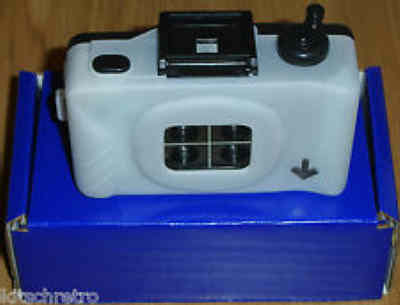
Same as the Oktomat. Sold by Hanimex.
Same as the Selby Revolver
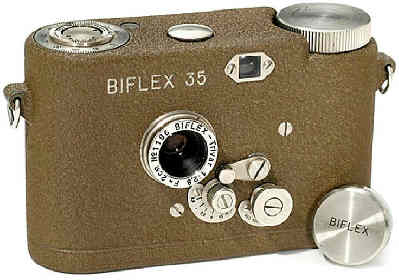
(1948) An exceedingly curious and rare submini from Germany/Switzerland is the Biflex. It managed to take 200 exposures on a roll of 35mm film by placing them in two rows on the film. They were 11x11mm in size. It did this by using a cassette flipping system -- the film was fed from one cassette into another. The pictures were exposed on the "top row" and then the cassettes were flipped over and run through the camera again, for another 100 exposures on the bottom row -- which is now the top row. You get the picture. The lens is usually a 20mm (f2.8). It is thought that fewer than 500 were made. Shutter speeds are from 1/10 through 1/250. Who knows what the rear lens thread was? Framing was through a very small peephole viewfinder. Despite the Biflex name, it is NOT a Twin Lens Reflex. The images were designed to be viewed as slides since many slide accessories were made such as a slide projector with two, fast lenses and various slide holders and trays.
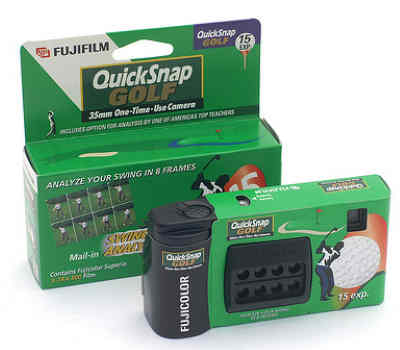
(1999) It is similar in style and function to the "Revolver" cameras, except that this camera has eight -- that's right, 8 -- lenses. It takes eight, rapid-fire pictures on one section of 35mm film with a sequential shutter of some sort. That's the "golf" part -- you can analyze your golf swing. Each image is about 9x12mm -- just a tiny bit bigger than the Minox format. The big difference between this camera and other "sequence" cameras is that this camera is a "disposable". The Revolver-types are reusable cameras. The Golf comes with 15 "exposures" -- that makes eight 9x12mm exposures each -- on 800 speed film for about $25. That's 15 exposures, i.e. pictures, with eight pictures in each of the 15 exposures. Since it is a disposable, the film cannot be changed, and it costs you $25 each time -- plus processing. I suppose, like other disposables, that the film can be changed with some effort, and the camera re-used. But you'll still be stuck with having to use 800 speed film -- or there abouts -- since the shutter speed and aperture are fixed. It is the same as the Action Shot 16 that was sold by Hanimex.
See Fuji Quicksnap Golf
Same as the Selby Revolver but with a colorful, transparent body.
See other cameras on this list.
Same as the original but with a solid body in milk or chrome.
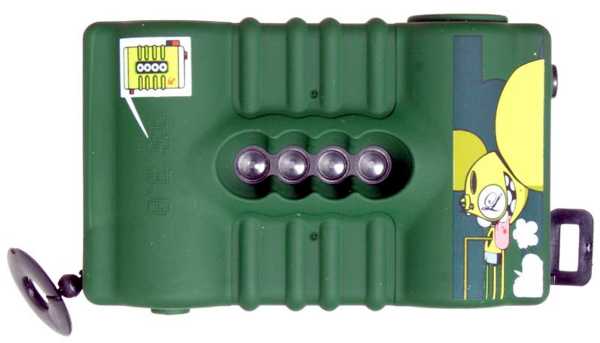
A new twist on the original Action Sampler. This camera still has four lenses and it still takes four pictures with the press of the shutter release. But instead of quarter-frame images these are 4 panoramic shots -- stacked one above the other. You can select the shutter speed of two seconds (one shot every 1/2 second) or four shots in 1/4 second (one shot every 1/15 second). The images are 8 x 24mm using a 20mm lens going across the 35mm roll. The images are not as wide as you would imaginge from a 20mm lens, because the images are across the short width of the film. Think of it as more like a 28mm lens. ISO 400 film is best for this camera. Available in various colors. The film is advanced by pulling a string -- so be careful!!!
(1970) This camera takes 35mm film, and instantaneously creates two 12x13mm images for stereo use. Apparently these are designed for Viewmaster use. The camera itself is a bit on the chintzy side. Twin 25mm f 3.5 lenses.
Same as the Selby Revolver
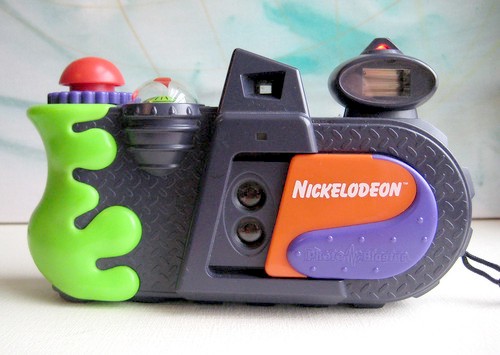
See PhotoBlaster
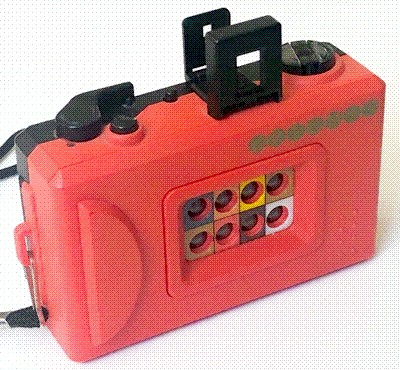
The Oktomat is very similar to the Fuji Quicksnap Golf in that it takes eight pictures within two and a half seconds with a single press of the shutter release. The main different is that the Oktomat is reloadable, unlike the Fuji. The exposures are all at f8 and 1/100 second. Sales might have been better if they called it the Octopus.
Same as the Selby Revolver, but with a less violent name.
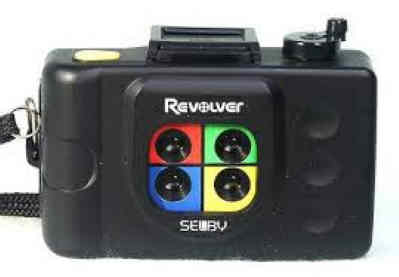
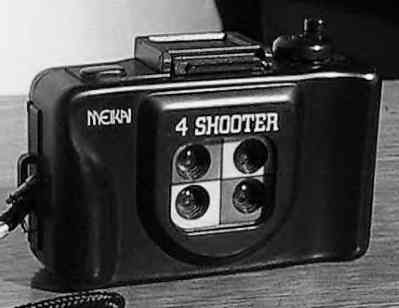
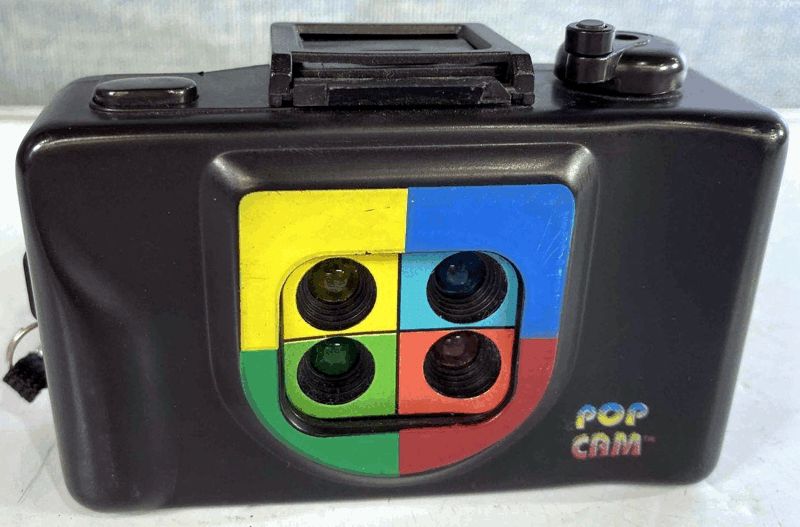
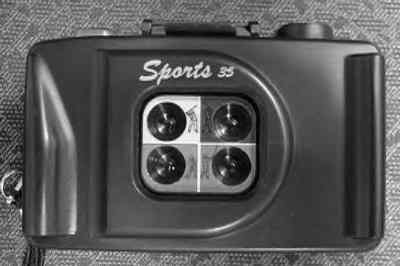
A camera designed to take "action" sequences. It uses regular 35mm film, but accomplishes the sequences without a motor drive. It has a rather strange, "rotary" shutter that exposes four 12x17mm images in each of the four "quarters" of the 35mm film -- in rapid sequence. By pressing the shutter release once, you get four images taken in about a second. This requires that the camera have four lenses, and consequently some people think it is a 3-D camera. Single shutter speed and single aperture. Cheapo plastic lenses, probably about 20mm. Probably about 1/125 at f-11 since the instructions recommend ISO 100 speed film. The camera has a pop-up sports finder on the top. A little bigger than the Olympus XA series -- and a lot less expensive. Lots of accessories available, such as a wrist strap. Film counter on the bottom. Available with other names, such as the POP CAM, the LOMO ACTION SAMPLER, and the SPORTS 35.
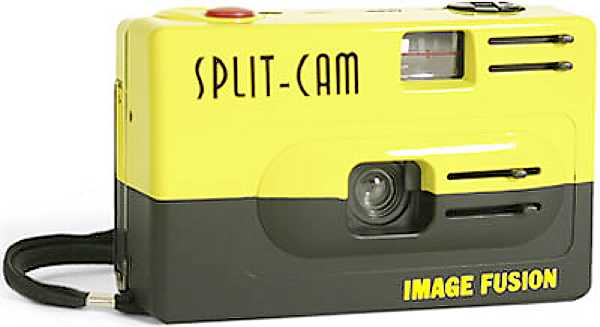
Another unusual camera from Lomography -- this time to split up the image into two horizontal shots. It has slats that are slid into place -- over the lens AND the viewfinder so what you see is what you get. It, of course, has a multi-exposure capability so that you can cock the shutter for the additional exposure(s). This allows you to take endless, multiple exposures for creative effects. Single shutter speed (1/100) and single aperture (f8). Cheapo plastic lens -- probably about 28mm. Not a small camera, but verey light.
Same as the Selby Revolver, but in a sportier body.
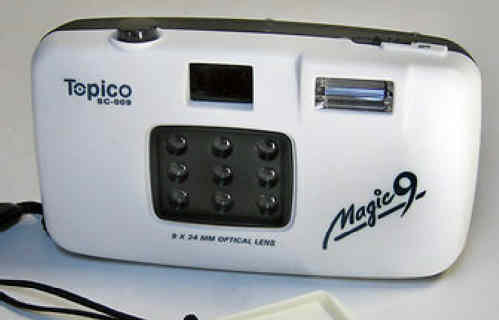
Similar to the Fuji Golf, but this camera takes 9 images and has 9 lenses -- three lenses in three rows on 35mm film. In addition, unlike the Golf, the images are not taken in sequence. It takes them all at the same time. The images are 7.5x11mm so if you have a 8x10 inch print made, each image will be about two-inch prints. Great for a wallet, I guess. The lenses are 24mm f11 optics, so a slight tele-photo effect is achieved. Built in flash even!!! Probably uses one or two AA batteries.
COPYRIGHT @ 1995-2022 by Joe McGloin. All Rights Reserved.