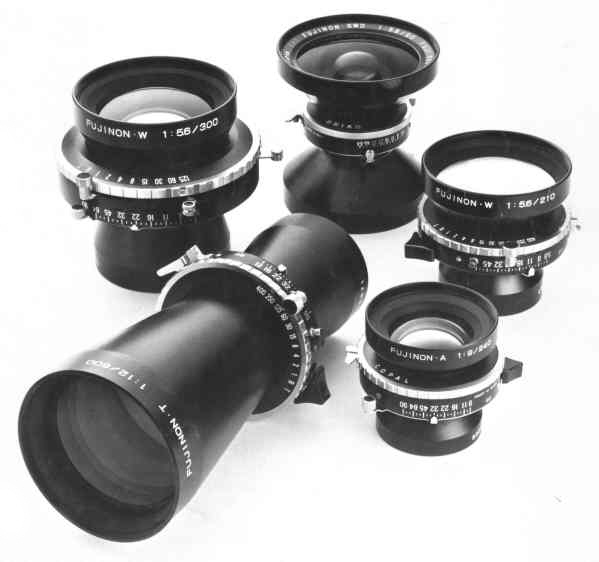
THE WEB'S MOST COMPLETE
FUJINON LARGE FORMAT LENS LIST
If you are viewing this page, you are undoubtedly aware of the great line
of large-format lenses that Fujinon makes and made over the years. On
these pages you will find the best, most comprehensive information available
on the web regarding these lenses. However, this information is not complete
and most certainly contains inaccuracies. The information has been
gleaned from the many Fujinon large format lenses that I own or have owned,
as well as Fuji literature, but Fuji literature contains several obvious
errors. These have been corrected, where they are known or obvious, but other
erros still exist and undoubtedly show up on the lists on these pages.
Several of the Fujinon large format lenses were produced with small
variations which are not detailed in their literature. Still we have tried
to list them here when we are informed about them. If you have information
that can help update this list, please let us know by emailing
XKAES@AOL.COM.
Before exploring the lists, we recommend you take a look at
FIELD CAMERA. It
is a free, on-line discussion group with dozens of members also interested
in this topic. See you there!
KEY TO THE LISTS:
-
SERIES: The series code is the general designation given to the
lens group by Fuji. Different series had different purposes -- such
as macrophotography or telephotography -- even though their specifications,
such as focal length, may appear to be the same.
-
The SWD series (SUPER WIDE DELUXE) of wide-angle lenses are deluxe
super-wideangle lenses with extra wide f5.6 apertures and an eight
element design. Their EBC (Electron Beam Coating) minimizes internal
reflections that often occur with lenses this wide. A wide coverage angle
and short focal length facilitates photography in confined areas, and
architectural photography which emphasizes interiors. This series offers
greater coverage and greater swing-tilt movements.
-
The SW series (SUPER WIDE) of wide-angle lenses offers slightly less coverage
than the SWD series and smaller apertures -- but at significant savings.
The apertures of f8, with a 6-element, 4-group design, helps to
substantially reduce the size and weight of the lenses, as well. SW lenses
provide excellent costperformance for practical applications. These
lenses were the forerunner to the NSW series.
-
The NSW series (NEW SUPER WIDE) of wide-angle lenses is an updated version
of the SW series and offers slightly less coverage than the SWD series and
smaller apertures -- at significant savings. Apertures are f8 and the
air-spaced, 6-element, 6-group lenses are advantageous for photography with
a small lens aperture. NSW lenses provide excellent costperformance
for practical applications.
-
The W series (WIDE) of normal lenses allows for almost unlimited camera movement
because of their wide angle of coverage. The six-element, four-group design
provides rich gradation, faithful reproduction of colors and textures, and
almost non-existent aberration and glare. These lenses were the forerunner
to the NW series.
-
The NW series (NEW WIDE) of normal lenses is an updated version of the W
series and offers standard lenses that features an improved 6-element, 6-group
design providing complete aberration compensation. These lenses are only
marked "W", instead of "NW", which leads to a lot of confusion.
-
The L series (LONG) offers a modified Tessar-type lens that features excellent
performance with a minimum reduction in angle of coverage. By reducing
the angle of coverage, the number of elements can be reduced -- as well as
the price tag.
-
The T series (TELEPHOTO) offers true telephoto lenses that require much less
bellow draw than a normal lens. These are large, heavy lenses, but
perfect for field cameras or other situations where bellows draw is limited.
-
The SF series (SOFT FOCUS) offers soft-focus results that are perfect for
many situations, such as portraits. The degree of softness is perfectly
controllable with insertable special discs and changing the f-stop.
-
The C series (COMPACT) offers compact lenses in longer focal lengths. By
reducing the maximum aperture, the number of elements can be reduced and
the size and weight of the lenses are dropped to a minimum. These are
perfect for situations where weight is a big concern, such as in backpacking.
-
The CM-W series is the latest line from Fuji and designed to compete with
the best APO lenses from other manufacturers.
-
The A series (APOCHROMATIC) of apochromatic lenses are designed for optimum
results in close-up work with minimal aberrations at close-distances.
-
The non-seried Fuji lenses have limited covering power, but wide apertures.
They are only available "in barrel" -- meaning without a shutter.
To complicate matters, some lens are not marked (engraved) with the correct
series name. For example, all NW lenses are marked W. Then there
are the non-series large format lenses from Fuji. For some reason these
lenses were not given a series name, but they are still usable for large
format work.
-
FOCAL LENGTH: Fuji large format lenses run from 65mm to
1200mm -- quite a spread. Keep in mind that on many lenses, the focal
length is not the same as the distance needed between the lens board and
the film plane. For example, the T series lenses need about half of
their focal length behind the lens board to focus at infinity. For
example, the 600mm T needs 325mm space to focus to infinity.
-
f-STOP: The number listed is the maximum aperture.
-
ELEMENTS: Generally speaking, the larger the aperture and/or the
greater angle of coverage, the more elements are needed to correct for various
optical aberrations. A lens with few elements can give excellent results
if the aperture or coverage are small.
-
GROUPS: Most large format camera lenses are based on a design
where some of the glass elements are cemented together. This is why
the number of groups is typically smaller than the number of glass elements.
Fujinon was a pioneer in the manufacture of air-spaced lenses where
the number of groups is the same as the number of elements since none of
the elements are glued together. While more difficult and more costly
to make, these lenses yield significantly sharper images across the entire
film plane.
-
ANGLE OF COVERAGE: Not to be confused with the angle of
view, the angle of coverage determines how wide the image circle will be.
-
IMAGE CIRCLE: The image circle determines what film formats
can be used. You'll need an image circle greater than 150mm for 4x5
work, for example.
-
SHUTTER: Fuji lenses came with various shutters: Seiko #0, Copal
#0, Copal #1, and Copal #3. These are abbreviated on the lists. C1
means Copal #1, for example. A ?0 means that the shutter was a #0,
but it is unclear if it was Seiko or Copal. There are also BARREL lenses
which were sold without shutters.
-
FILTER: The diameter of the front filter thread.
-
COATING: Two coatings were applied to Fuji lenses, either a single
coating or their famous EBC (Electron Beam Coating) multi-coating. The
more glass-to-air surfaces a lens has, the more it can benefit from
multi-coating. Single coating will work fine with most lenses in most
situations.
-
OTHER: Comments are listed in this column.